
Homophobes Swim For Help To The Pride Boat They Were Just Harassing After Their Own Boat Explodes
Th3
If you’ve ever wished the universe came with a “mute” button for hecklers, Moses Lake, Washington delivered something
closeminus the part where anyone should be cheering for danger. In a viral boating clip from Memorial Day weekend
2021, a group flying Pride flags is allegedly harassed on the water… and moments later ends up rescuing the very people
who were causing the trouble. It’s a story that internet culture labeled “karma,” but the more useful takeaway is
simpler: safety and basic decency matter, especially when you’re surrounded by fuel, waves, and very limited exits.
What happened on Moses Lake: a quick timeline of a not-so-fun day on the water
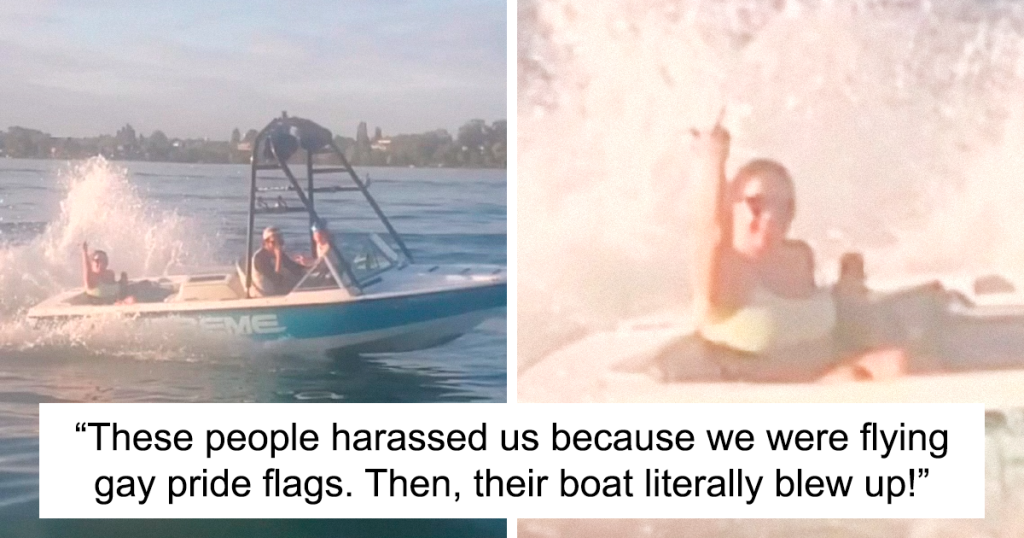
The core facts are consistent across reporting: On May 30, 2021, video from Moses Lake shows a boat flying Pride flags
being circled and heckled by occupants of another vessel. The confrontation escalates visuallythere’s a middle finger,
fast passes, and alleged slurs. Then the other boat erupts into flames (some accounts describe an explosion), forcing its
occupants into the water. The Pride-flag boat, instead of drifting away or filming from a safe distance, moves in and pulls
people out. Deputies and responders later address the fire, and the sheriff’s office indicates it investigated the incident
as information came in. The rescue is the undeniable centerpiece: someone was in immediate danger, and the people who’d
been targeted chose to help anyway.
Why the clip went viral: “karma” is clickable, but courage is the real headline
The internet loves a neat moral arc: bully → instant consequences → poetic ending. That structure is practically
algorithm catnip. Add a Pride flag (a symbol that already triggers strong opinions), the timing near the start of Pride
Month, and a dramatic boat fire, and you’ve got a story that spreads faster than sunscreen on a July dock.
But “karma” isn’t a safety plan. What actually happenedaccording to multiple reportsis that a family or group who felt
threatened made a split-second decision to do the right thing. They approached a burning vessel and assisted swimmers in
distress. That isn’t just a plot twist. That’s seamanship, humanity, and a level of restraint that deserves more attention
than the internet’s favorite sound effect.
The big lesson: on the water, your worst moment can become someone else’s emergency
Boating cultureat its bestruns on an unwritten rule: you help when help is needed. That’s not about liking someone,
agreeing with them, or giving them a gold star for their personality. It’s about acknowledging that water is an equal-opportunity
hazard. Engines fail. People fall. Fires happen. And when they do, the difference between “wild story” and “tragedy” can be
one nearby boat that chooses action over outrage.
The Pride-flag boat’s response is also a reminder that targeted communities often end up doing emotional labor and
literal laborstaying calm, staying safe, and still showing care. You don’t have to romanticize that reality to learn from it.
You can simply say: that was brave, and it likely prevented serious harm.
Harassment on the water: practical ways to stay safer without turning into a sequel
If you’re ever on the receiving end of harassment while boatingwhether it’s Pride-related or just plain aggressive behavioryour
priority is to reduce risk, not “win.” Here are safer, more realistic moves:
- Create distance early. If another boat starts circling or crowding, change direction, reduce speed, and move toward areas with more traffic or closer to shore.
- Don’t mirror their chaos. Avoid sudden acceleration battles, tight turns, or “teaching them a lesson.” That’s how collisions happen.
- Document without escalating. If it’s safe, record brief video, note the boat’s registration numbers, description, and location. Don’t lean over rails or take your eyes off navigation to film.
- Use communication tools. A VHF radio (where applicable), phone call, or marina contact can be more effective than shouting across water. If you feel in danger, contact local authorities.
- Keep people wearing life jackets. Harassment can distract a crew. Life jackets reduce consequences if someone falls or if you must stop suddenly.
- Have an “exit plan.” Before you fly any flag or signage (Pride or otherwise), consider: Where’s the nearest dock? How quickly can you get there? Who’s driving if you’re rattled?
None of this is about shrinking yourself. It’s about refusing to give a dangerous situation extra fuelliteral or emotional.
Boat fires and “explosions”: the unglamorous science behind a dramatic moment
A boat fire can look like a movie scene, but the mechanics are often painfully ordinary. Gasoline vapors are heavier than air,
can collect in low areas (like bilges and engine compartments), and can ignite from a spark or backfire. That’s why boating safety
guidance repeatedly emphasizes ventilation, the “sniff test,” and careful fueling practices. When vapors build up and ignite, the
result can be sudden flame spread or a blast-like event that people describe as an explosion.
Reporting around the Moses Lake incident included speculation about mechanical trouble as a possible causean example of how quickly
“messing around” can collide with physics and fuel.
If you boat (or love someone who boats), these basics are worth repeating:
- Fuel smart. Fuel vapors spread rapidly; check bilges/compartments and use your nose before starting.
- Ventilate before ignition. Guidance commonly stresses running ventilation/blowers before starting certain gasoline engines and after maintenance.
- Carry and know your fire extinguisher. Having one is good; knowing how to use it quickly is better.
- Don’t store “surprises” near heat. Fireworks, fuel containers, and loose battery gear turn small problems into big emergencies.
- Stop early if you smell fuel. Treat fuel odor like a smoke alarm you can’t ignore.
“They need help!”: what the law and boating ethics say about rescues
Even if you’ve just been harassed, a person in the water can be in life-threatening danger fastfatigue, shock, burns, inhalation,
panic, and waves don’t negotiate. In the U.S., there’s also a legal concept of rendering assistance: federal law includes a duty for
a vessel’s person in charge to render aid to individuals in danger of being lost at sea when it can be done without serious danger to
the rescuer’s vessel or people aboard.
The important part is the safety clause: you help as far as you can without creating another emergency. Sometimes the safest help
is calling authorities, throwing flotation, and standing by. Sometimes it’s carefully bringing someone aboard. The Pride-flag boat’s choice
in this story is a textbook example of “help, but don’t escalate.”
Pride on the water isn’t rareand that visibility is exactly the point
One reason this story hit so hard is that Pride doesn’t only happen on city streets. Across the U.S., there are Pride flotillas, cruises,
and “Pride on water” fundraisers that celebrate LGBTQ+ joy in places that aren’t always assumed to be welcoming. FLoatarama in Fort Lauderdale
bills itself as a major Pride-on-water fundraiser, and community Pride flotillasfrom human-powered boats on the Mystic River to organized Pride
flotillas in Chicagoshow how visibility and belonging can float, paddle, sail, and sparkle.
That’s why harassment in these spaces feels so personal: it tries to evict people from public life. The responseshowing up anyway, safely,
proudly, and with a planis how communities keep the water (and the world) open to everyone.
Conclusion: the moral isn’t “karma”it’s responsibility
The Moses Lake Pride boat rescue story is memorable because it’s dramatic, ironic, and oddly cinematic. But the lasting message isn’t
“gotcha.” It’s that decency can be practiced under stress, and safety should never be optional. Harassment is dangerous. Boat fires are
terrifying. And when someone is in the water, the right move is to helpcarefully, smartly, and without turning your boat into the next headline.
Experiences related to this topic (extra reflections from Pride-on-the-water moments)
Talk to enough LGBTQ+ folks who spend time on lakes, rivers, and coasts, and you’ll hear a familiar pattern: the water can feel like freedom
until someone decides your existence is a debate topic. Many people describe the simple act of putting up a Pride flag as both joyful and strategic.
Joyful because it’s a bright, public “we’re here.” Strategic because it’s a visibility testan honest read on whether a space is actually safe or
only “safe as long as you don’t look too queer about it.”
One common experience is the quiet math you do before you ever leave the dock. Who’s driving? Do we have enough life jackets for everyoneand are
they easy to grab, not buried under snacks and towels? Is the phone charged? Do we know the nearest marina or public ramp? People don’t always name
that as “hypervigilance,” but the planning has the same flavor: hope for the best, prepare for the weird.
Then there’s the good stuffbecause it’s not all tension. Plenty of boaters say they get supportive waves, thumbs-up gestures, and “Happy Pride!”
shouted across the water in the most wholesome, dad-on-a-pontoon voice imaginable. Sometimes another boat falls into an unspoken formation, like a tiny
rainbow escort. In those moments, a flag becomes a magnet for community. You’re not just boating; you’re being seen kindly.
But the negative moments tend to be sharper and more memorable. People describe a boat veering a little too close, someone yelling something that
turns your stomach, or a group circling “as a joke” that doesn’t feel like a joke at all. The emotional experience is oddly split: part adrenaline,
part disbelief, part “I refuse to let this ruin my day.” Many people say the best decision they ever made in those situations was choosing safety over
prideful argumentcreating distance, heading toward busier water, and documenting calmly. It’s not satisfying in the way a movie confrontation is
satisfying, but it gets you home.
The most powerful shared experience, though, is what happens when something goes wrong for anyone nearby. On the water, emergencies erase
social categories fast. A person overboard is a person overboard. A boat smoking is a boat smoking. People who have been targeted often talk about how
quickly they switch into practical mode: throw a float, kill the engine to avoid prop danger, approach carefully, get someone stable, call for help.
Later, when the shaking startsbecause it always starts laterthere’s often a strange pride in having acted with integrity. Not because the other party
“deserved saving,” but because the rescuer deserved to remain the kind of person who saves.
That’s why the Moses Lake story keeps circulating. It captures an experience many people recognize: the world can be hostile, sometimes absurdly so,
and yet you still get to choose your response. Pride on the water is about joy, yesbut it’s also about belonging, preparation, and the stubborn belief
that public spaces are for everyone. If you’re going to fly a flag, bring a plan. If you’re going to share the water, bring respect. And if you ever
see someone swimming toward you in panic, remember the best boating tradition of all: help first, sort out feelings later.
SEO Tags
